
 EN
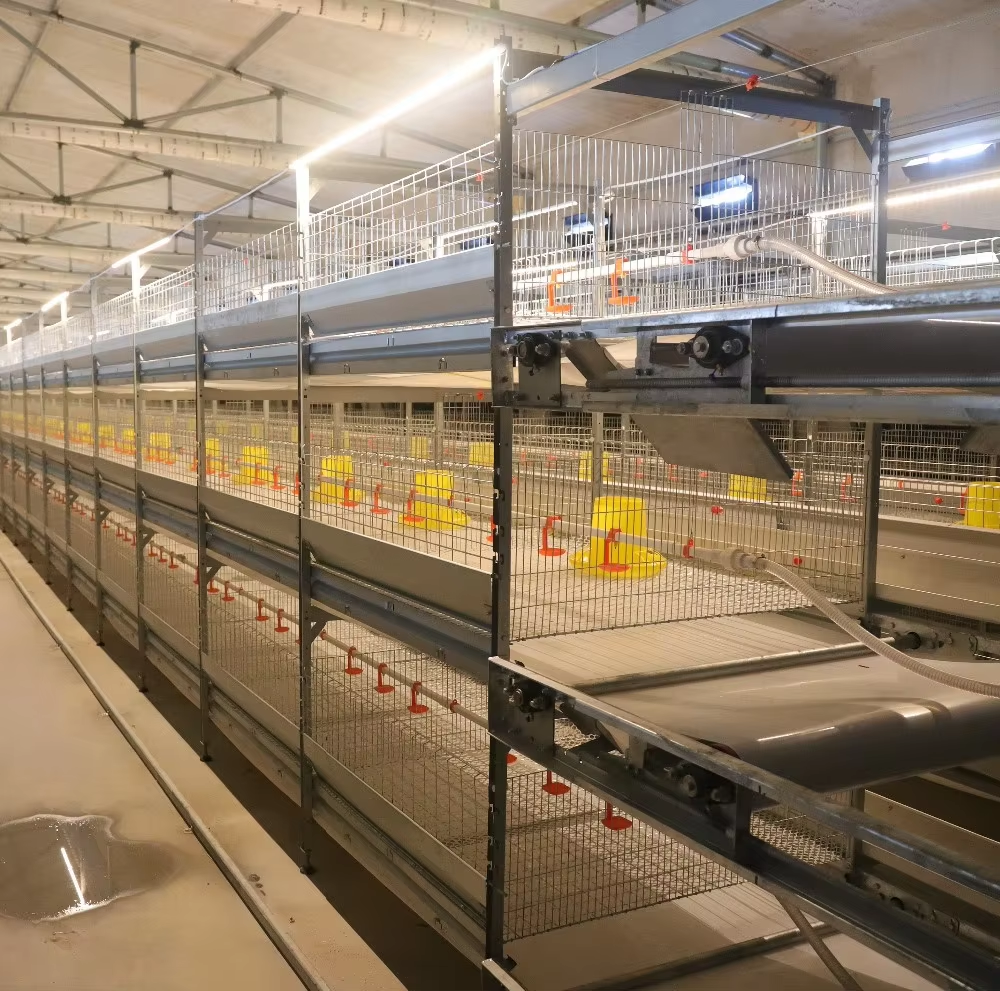
Structural Integrity and Material Specifications for Layer Chicken Cage Durability
Galvanized steel grade (ASTM A653 G90 vs. G185) and coating thickness impact on corrosion resistance and service life
Zinc coating mass under ASTM A653 is the primary predictor of corrosion resistance. G90 specifies approximately 275 g/m² of zinc total on both sides, while G185 specifies roughly 564 g/m² (ASTM A653, 2023). This near-doubling of sacrificial zinc significantly enhances protection in ammonia- and moisture-rich poultry house environments. Field data show G90-coated frameworks typically last 7–10 years under moderate conditions, whereas G185-coated components often reach 15–20 years in continuous manure exposure. The thicker G185 layer also improves edge and weld coverage—critical for preventing localized rust at cut ends and wire-floor joints.
Facility managers commonly deploy G90 for upper tiers and reserve G185 for high-exposure zones: lower supports, droppings trays, and manure scraper contact points. In high-performance installations targeting a service life exceeding 12 years—and where ammonia levels remain consistently below 25 ppm—G185 is justified for structural frames and wire floors. Coating thickness directly influences replacement frequency, operational downtime, and total cost of ownership. While G90 remains appropriate for indoor cages with controlled ventilation and low humidity, proximity to manure belts warrants the heavier G185 specification.
Tier configuration analysis: 3-tier, 4-tier, and H-type layouts — effects on load distribution, maintenance access, and labor efficiency
Tier count fundamentally shapes load distribution, daily workflow, and infrastructure demands. Three-tier configurations keep top cage height within 1.8–2.1 m—enabling manual inspection and egg collection without mobile platforms. Four-tier systems increase birds per square meter by 25–33% compared with three-tier arrangements, but impose greater vertical load on support columns and floor slabs. H-type layouts—typically stacking 3–8 tiers on a central beam frame with 2.75–3.5 mm hot-dip galvanized supports—improve load transfer to the floor and reduce structural sway.
Maintenance access becomes more complex as tier height increases; automated feeding and egg belts offset routine labor but require elevated walkways and fall-protection protocols. Labor efficiency peaks in H-type layouts featuring centralized egg collection and multi-level manure belts. A four-tier H-type configuration can reduce manual egg gathering time by 30–40% versus conventional three-tier systems—but routine inspection and bird removal demand longer access times and strict safety compliance. Floor slab capacity must be validated before installation, especially in retrofitted barns.
Welfare-Compliant Space Allocation and Behavioral Requirements for Layer Chicken Cage Systems
Welfare-compliant space allocation must reconcile regulatory minimums with production goals. Stocking density is the primary design input—but its expression varies across markets and cannot be assumed interchangeable.
Stocking density benchmarks (in²/bird, cm²/bird, birds/m²) across EU, USDA, and ASEAN regulatory frameworks
Regulatory minimums differ markedly. The EU Enriched Cage Directive (1999/74/EC) mandates 750 cm² total cage area per bird, with at least 600 cm² usable area—equivalent to ≈13.3 birds/m². In contrast, the USDA sets no federal stocking-density standard for caged layers; industry practice follows United Egg Producers (UEP) guidelines of 432–555 cm² (67–86 in²) per bird, or ≈18–23 birds/m². ASEAN lacks a unified binding standard; most commercial installations align with importer or certification requirements—commonly specifying 450–550 cm² (70–85 in²) per bird.
| Regulatory framework | Space per bird | Density equivalent |
|---|---|---|
| EU enriched cage (Directive 1999/74/EC) | 750 cm² total / 600 cm² usable (116 in² / 93 in²) | ≈13.3 birds/m² |
| USDA / United Egg Producers guideline | 432–555 cm² (67–86 in²) | ≈18–23 birds/m² |
| ASEAN buyer/certification-led specs | 450–550 cm² (70–85 in²) | ≈18–22 birds/m² |
Use this table as a screening tool: a cage certified for one market may not satisfy another’s welfare or import requirements.
Behavioral space metrics: perch length (≥15 cm/bird) and nest area (≥0.07 m²/bird) as critical co-factors in cage design validation
Space quantity alone does not ensure welfare compliance. Behavioral space metrics determine whether hens can perform essential activities without competition or stress. A perch length of at least 15 cm per bird supports simultaneous roosting and reduces nighttime aggression; a nest area of at least 0.07 m² per bird supports pre-laying behavior and lowers floor-egg rates. Enriched systems incorporating both features reduce abnormal repetitive behavior by up to 57%, according to a 2025 University of Pretoria study.
Buyers should treat perch length and nest area as pass/fail validation criteria—alongside stocking density. A cage meeting density requirements but lacking adequate perch or nest space risks failing welfare audits, compromising egg quality, and increasing labor for floor-egg collection.
Integrated Environmental Control Performance in Layer Chicken Cage Installations
Environmental control directly affects flock uniformity, eggshell quality, and respiratory health. In high-performance layer chicken cage systems, ventilation and lighting must be precisely calibrated to house layout, bird density, and production stage.
Ventilation requirements: CFM per bird (0.6–0.9) calibrated to heat dissipation and ammonia control (<25 ppm)
Ventilation rates should be maintained at 0.6–0.9 CFM per bird to effectively remove metabolic heat, moisture, and airborne contaminants—including ammonia. This range supports thermal comfort while keeping ammonia concentrations below 25 ppm, the evidence-based threshold above which respiratory stress and measurable egg production losses begin. In high-density, multi-tier layouts, airflow must be verified at cage level, not only at fan outlets. Uniform inlet distribution prevents stagnant zones where ammonia accumulates. Automated sensors linked to staged fan controls enable real-time response to temperature and humidity shifts—preserving feed intake and shell integrity. Operators should set alarm thresholds below 25 ppm so corrective action begins before sustained exposure occurs.
Lighting design: lux intensity (10–20 lux at perch level) and photoperiod alignment with peak laying phases
Light intensity of 10–20 lux at perch level is sufficient to stimulate reproductive activity and suppress injurious pecking. During peak laying phases, photoperiod should remain stable and age-appropriate—typically 14–16 hours of light. Gradual adjustments, rather than abrupt changes, support consistent ovulation and optimal eggshell deposition. Timers and dimmers must ensure uniform light distribution across all tiers. Crucially, dark periods of at least 6 continuous hours are required to maintain healthy melatonin cycles and feather condition.
Egg Collection System Efficiency and Reliability in Layer Chicken Cage Operations
Egg collection in modern layer chicken cage installations must balance speed, gentleness, and uptime. A well-integrated roll-out floor or egg belt moves eggs away from birds immediately after lay—reducing pecking, soiling, and micro-cracks. Farm-level assessments confirm automated collection cuts manual handling time by 40–60%, while egg processing speed improves by ~18% compared with manual tray collection.
Reliable operation depends on smooth transfers at each tier junction and adjustable belt speed matched to flock age and laying intensity. Gentle gradient angles, soft brush or finger diverters, and low-drop transfer points keep shell damage below 1% in well-designed systems. Well-maintained belt drives and sensor-based controls routinely achieve downtime under 0.5%, preventing production bottlenecks.
| Parameter | Typical target |
|---|---|
| Egg damage rate | < 1% |
| Collection downtime | < 0.5% |
| Labor reduction vs. manual | 40–60% |
| Egg processing speed gain | ~18% |
Because collection surfaces undergo frequent sanitation and ammonia exposure, polypropylene or food-grade PVC belts—and corrosion-resistant rollers—are standard choices. These materials retain tension, resist degradation, and sustain consistent throughput. Ultimately, egg collection efficiency hinges on low-stress bird flow, mechanical redundancy, and accessible inspection points that keep maintenance short and predictable.
FAQ
What is the lifespan of G90 and G185 coatings?
G90-coated frameworks typically last 7-10 years under moderate conditions, while G185-coated components often reach 15-20 years, particularly in continuous manure exposure.
What are the benefits of H-type layouts in layer chicken cage systems?
H-type layouts improve load transfer to the floor, reduce structural sway, and enhance labor efficiency due to centralized egg collection and multi-level manure belts.
How does space allocation impact welfare compliance in layer chicken cages?
Regulations like the EU Directive (1999/74/EC) and USDA guidelines determine minimum space per bird, while perch length and nest area are critical for supporting natural behaviors and reducing stress.
What is the recommended ventilation rate for layer chicken cages?
Ventilation rates of 0.6–0.9 CFM per bird are recommended to control metabolic heat, moisture, and ammonia levels, ensuring bird health and productivity.
How do automated egg collection systems improve efficiency?
Automated systems reduce manual handling time by 40-60%, improve egg processing speed by ~18%, and maintain egg damage rates below 1% with proper design and maintenance.
Table of Contents
- Structural Integrity and Material Specifications for Layer Chicken Cage Durability
- Welfare-Compliant Space Allocation and Behavioral Requirements for Layer Chicken Cage Systems
- Integrated Environmental Control Performance in Layer Chicken Cage Installations
- Egg Collection System Efficiency and Reliability in Layer Chicken Cage Operations
-
FAQ
- What is the lifespan of G90 and G185 coatings?
- What are the benefits of H-type layouts in layer chicken cage systems?
- How does space allocation impact welfare compliance in layer chicken cages?
- What is the recommended ventilation rate for layer chicken cages?
- How do automated egg collection systems improve efficiency?