
 EN
EN
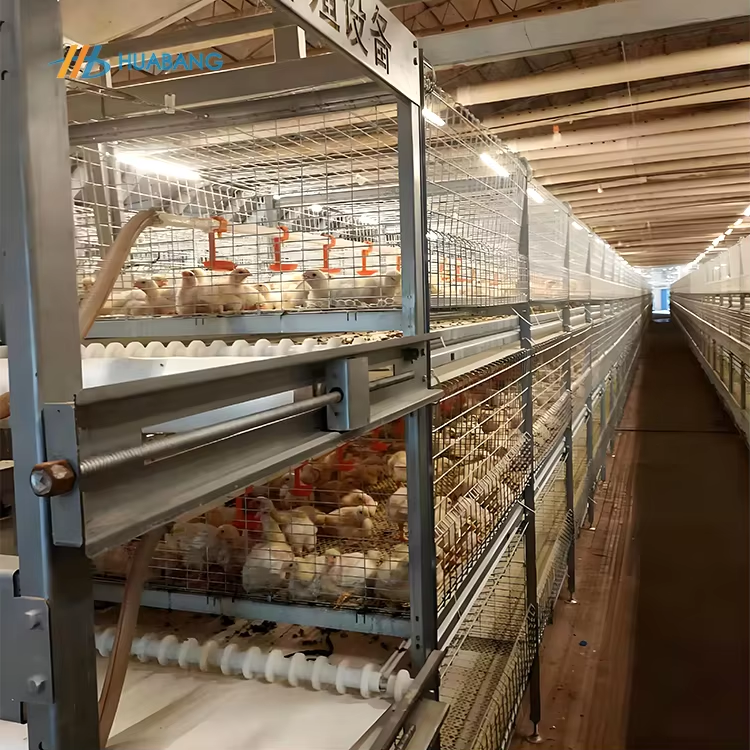
Integrated Design: How Layer Chicken Cage Architecture Enables Seamless Manure Belt Integration
Tiered cage frame geometry and under-cage clearance requirements for reliable belt installation
The multi-tier frame geometry of a layer chicken cage system is foundational to reliable manure belt integration. Each tier slopes slightly forward, and the supporting structure must provide a minimum under-cage clearance of 250 mm—sufficient to house the belt, its rollers, and drive mechanism. This dimension is not arbitrary: it prevents smearing of manure against the cage floor, enables safe access for inspection and belt replacement without dismantling upper tiers, and supports consistent belt tracking. Both A-frame and H-frame configurations can deliver the required open area, but vertical spacing between tiers must be precisely maintained—typically 300–350 mm from floor mesh to belt surface—to prevent sag and ensure uniform load distribution. The frame itself absorbs belt tension, so bracing points are engineered to anchor return rollers and guide rails. When geometry is optimized, droppings land centrally on the belt, and full-row travel occurs without side-tracking. Field experience confirms that deviations as small as 15 mm in clearance frequently cause misalignment and premature wear—making dimensional precision in frame fabrication a non-negotiable prerequisite for integrated manure handling.
Standardized row spacing, height gradients, and belt width compatibility across commercial layer chicken cage systems
Commercial layer chicken cage systems rely on standardized dimensional protocols to ensure interoperability and scalability of manure belts. Row centres are consistently spaced at 1.2–1.5 m, balancing aisle width for belt-drive access and cross-conveyor integration. Tier-to-tier height gradients follow a controlled 0.5–1% slope—enough to support gravity-assisted manure transfer without compromising belt grip on the drive drum. Belt width is matched directly to cage width, with industry-standard options of 600 mm, 750 mm, and 800 mm enabling full-side waste capture per tier. This alignment allows belts, scrapers, tensioning units, and discharge hoods to be sourced from a unified specification catalogue—eliminating custom engineering. When row spacing, slope, and belt width are coordinated, modular expansion becomes seamless, and automatic cross-belts beneath row ends can route manure to central collection without retrofitting. These norms reduce spare-part inventories, accelerate both initial commissioning and long-term maintenance, and reinforce system reliability across diverse housing layouts.
Operational Synergy: Labor Savings, Maintenance Efficiency, and Ventilation Coordination
Reduction in manual labor (up to 70%) through automated manure removal synchronized with layer chicken cage management cycles
Integrating automated manure removal with modern layer chicken cage systems fundamentally reshapes labor demand. By aligning belt operation with natural flock rhythms—such as overnight resting or post-feeding lulls—the system eliminates manual scraping and reduces direct handling time by up to 70%, according to 2023 industry benchmarking data. This shift transforms daily operations from physically intensive labor to real-time monitoring and exception-based intervention. Consistent, timed removal also prevents manure buildup and hardening, avoiding the labor-intensive deep cleaning otherwise required between flocks. As a result, skilled staff can be redirected toward higher-value responsibilities—including flock health assessment, environmental data analysis, and performance optimization. The operational cadence becomes predictable, scalable, and less reliant on large, dedicated cleaning crews. These labor efficiencies compound with every production cycle, forming a core enabler of modern, high-intensity egg production.
Environmental Performance: Ammonia Control, Moisture Management, and Air Quality Outcomes
Ammonia emission reduction (32–47%) enabled by frequent manure removal from layer chicken cage systems
Frequent, scheduled manure removal is a primary engineering lever for ammonia abatement in caged layer systems. Peer-reviewed field studies and regulatory compliance reports confirm emissions reductions of 32–47%, with variability tied to climate, ventilation rates, and operational consistency—not system design limits. The mechanism is biochemical: rapid separation of feces from the bird environment interrupts microbial urease activity before uric acid fully degrades into volatile ammonia. Delaying removal by just 24 hours can double emission rates under warm, humid conditions, as microbial metabolism accelerates exponentially. Crucially, this benefit depends on consistent timing—not just frequency. Irregular or reactive belt operation permits nitrogenous compounds to accumulate, resulting in episodic, high-concentration ammonia spikes. Synchronizing removal with daily flock activity patterns ensures steady, low-level nitrogen removal—directly improving air quality, reducing respiratory stress, and supporting sustained egg output. As such, the manure belt functions not only as a waste-handling component but as an active, integrated air quality control device.
Critical moisture thresholds (<25% wet basis) maintained via integrated drying fans positioned above manure belts beneath cages
Moisture content governs ammonia generation more than any other single factor—and the critical threshold is clear: manure must remain below 25% wet basis (i.e., ≥75% dry matter) to suppress urease-driven volatilization. At moisture levels above this point, microbial activity surges; below it, nitrogen remains largely bound in solid form. Integrated drying fans mounted directly above the manure belt—within the under-cage void—deliver targeted, low-velocity airflow that conditions manure in situ, preventing localized humidity pockets that trigger ammonia release. This approach avoids the pitfalls of whole-house dehumidification, which risks thermal stress or excessive energy use. Instead, airflow is calibrated to maintain litter moisture between 15–25%—a narrow but essential band—without compromising ambient house temperature. Proper fan placement and duty cycling ensure moisture control remains effective year-round: sufficient in summer to counteract evaporative loading, and modulated in winter to avoid chilling birds. The synergy between timed belt removal and precision drying creates a stable microenvironment beneath the cages—one that sustains air quality, protects flock health, and meets tightening environmental compliance standards.
FAQ Section
What is the role of tiered cage frame geometry in manure belt integration?
The tiered cage frame geometry ensures reliable manure belt integration by providing adequate clearance for the belt, its rollers, and drive mechanism, while maintaining dimensional precision to prevent misalignment and wear.
How does standardized row spacing and height gradients benefit layer chicken cage systems?
Standardized row spacing, height gradients, and belt widths ensure interoperability, scalability, and modular expansion of system components, simplifying commissioning and maintenance across diverse housing layouts.
How does automated manure removal reduce labor requirements?
By integrating automated manure removal synchronized with flock cycles, manual scraping is eliminated, reducing labor demands by up to 70%, while enabling staff to focus on higher-value tasks like health assessments and performance optimization.
How does frequent manure removal impact ammonia emissions?
Scheduled manure removal interrupts microbial urease activity, reducing ammonia emissions by 32–47%, improving air quality, and supporting better flock health and egg production.
How are moisture thresholds managed to control ammonia generation?
Integrated drying fans above manure belts maintain a critical moisture level below 25% wet basis, suppressing microbial activity and ammonia release without negatively impacting house temperature or bird health.
Table of Contents
- Integrated Design: How Layer Chicken Cage Architecture Enables Seamless Manure Belt Integration
- Operational Synergy: Labor Savings, Maintenance Efficiency, and Ventilation Coordination
- Environmental Performance: Ammonia Control, Moisture Management, and Air Quality Outcomes
-
FAQ Section
- What is the role of tiered cage frame geometry in manure belt integration?
- How does standardized row spacing and height gradients benefit layer chicken cage systems?
- How does automated manure removal reduce labor requirements?
- How does frequent manure removal impact ammonia emissions?
- How are moisture thresholds managed to control ammonia generation?