
 EN
EN
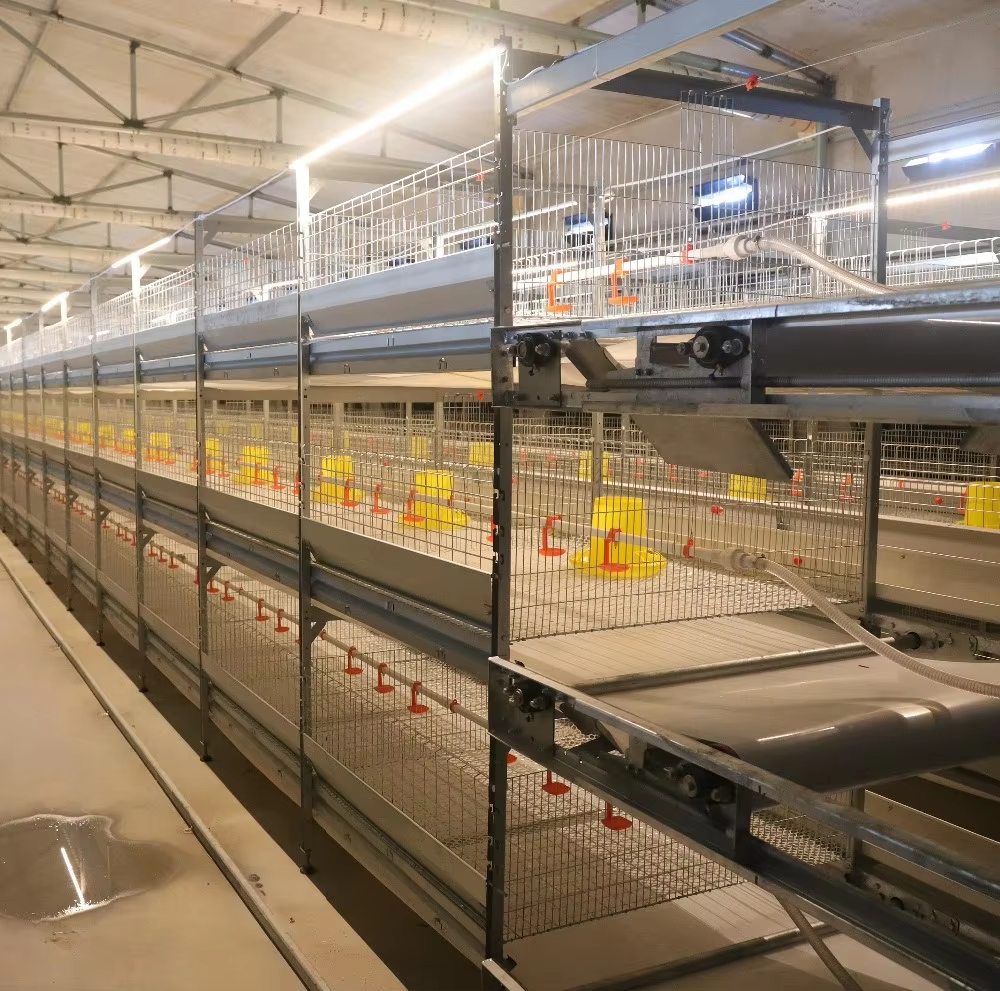
Core Components of Environmental Control Systems for Chicken Cage Operations
Ventilation, wet curtain cooling, and static pressure control in high-density chicken cage systems
High-density chicken cage operations demand robust environmental control to maintain flock health and productivity. Ventilation forms the backbone of this infrastructure—exchanging ammonia- and moisture-laden air with fresh air while stabilizing temperature. Tunnel ventilation, paired with evaporative wet curtain cooling, delivers rapid heat relief during hot periods: as air passes through saturated cellulose pads, incoming air temperature drops by 5–8°C within minutes, directly mitigating heat stress across stacked cage tiers. Static pressure control ensures balanced airflow from floor to ceiling—critical when cages are stacked three to five tiers high. By maintaining consistent negative pressure, farmers eliminate dead zones where poor air quality or overheating compromise bird welfare. When integrated effectively, these components sustain a stable microclimate that supports consistent feed intake, egg production, and respiratory health—even under extreme weather.
IoT sensors and automated controllers: Enabling real-time responsiveness in chicken cage environments
Modern environmental control systems rely on networks of IoT sensors to monitor temperature, humidity, CO₂, and ammonia levels in real time. Programmable logic controllers (PLCs) process this data and automatically adjust fans, cooling pads, heaters, and inlet curtains—without manual intervention. For example, if ammonia exceeds 20 ppm, the system increases ventilation until levels return to the target range (10–15 ppm), preventing immune suppression and performance loss. These systems also log historical data, enabling producers to refine setpoints for each production stage—from brooding to peak lay. The result is a self-regulating environment that optimizes bird comfort 24/7, reduces labor dependency, and shifts management from reactive to preventive. As noted by the USDA’s Agricultural Research Service, such automation is now foundational to scalable, welfare-aligned poultry production.
Climate Precision: Temperature, Humidity, and Air Quality Management in Chicken Cage Housing
In high‑density chicken cage operations, precision climate control directly influences flock health, immunity, and productivity. Temperature, humidity, and air quality must be managed dynamically—not just to meet averages, but to keep birds consistently within their thermal neutral zone. Broilers perform best between 75–85°F (24–29°C); layers require tighter staging, beginning at ~95°F at placement and tapering to 70–75°F by week eight. Insufficient airflow elevates ammonia concentrations—studies show levels can rise nearly 25% under stagnant conditions, increasing susceptibility to respiratory disease and reducing feed intake (Poultry Science, 2022). Maintaining optimal relative humidity (50–70%) further supports respiratory tract integrity and litter quality.
Dynamic climate setpoints and automation logic tailored to chicken cage layer and broiler production stages
Modern environmental controllers use age-, weight-, and behavior-based logic to adjust climate parameters in real time. For layers, temperature setpoints decline gradually over eight weeks, while ventilation rates scale upward to match metabolic heat output and maintain CO₂ below 3,000 ppm. Broiler houses demand even finer tuning: exhaust fans cycle two to three times per hour to remove excess heat and moisture without inducing chilling drafts—especially critical during the first 14 days, when thermoregulation is immature. This staged approach aligns environmental support with physiological development, maximizing growth efficiency and laying persistence.
Mitigating summer heat stress in chicken cage systems: Thresholds, intervention timing, and welfare outcomes
Heat stress begins when the effective temperature exceeds 85°F in caged flocks—and its impact escalates rapidly. Unmitigated, it can reduce egg production by up to 15% and increase mortality by over 20%. Automated interventions—triggered by ambient and bird-surface temperature sensors—activate before thresholds are breached. Wet curtain cooling and tunnel ventilation deploy within seconds; spray cooling systems achieve 5–8°C reductions in three to five minutes, restoring thermal balance before feed intake or immune function declines. Early, precise response not only preserves productivity but improves flock uniformity and behavioral indicators of welfare—including reduced panting, feather ruffling, and wing spreading.
Data-Driven Decision Making: From Monitoring to Optimization in Chicken Cage Farming
IoT sensors in modern chicken cage operations continuously capture granular data on environmental conditions, feed consumption patterns, and behavioral metrics—such as activity levels and perch usage. When aggregated and analyzed, this information transforms into actionable insights that improve feed efficiency, reduce mortality, and enhance flock uniformity. A 2023 ROI study comparing conventional and automated chicken cage farms revealed consistent, statistically significant gains:
| Metric | Conventional Farm | Automated Cage Farm | Improvement |
|---|---|---|---|
| Feed conversion rate | 2.4:1 | 2.1:1 | 12.5% |
| Mortality rate | 6.8% | 3.2% | 53% |
| Labor hours per 1,000 hens | 18 | 7 | 61% |
Farms leveraging predictive analytics—using sensor-derived trends to anticipate nutritional or environmental needs—report egg yield gains of 9–12%, driven by timely adjustments to lighting, ventilation, and feed formulation. This shift from intuition-based to evidence-based management enables repeatable, cycle-to-cycle performance improvement across commercial operations.
Production Impact: How Environmental Control Systems Elevate Performance in Chicken Cage Breeding
Quantifiable gains in egg production, feed conversion ratio (FCR), and growth consistency across chicken cage flocks
Environmental control systems deliver measurable, reproducible improvements across core KPIs in modern chicken cage breeding. Commercial data shows egg production increases of 15–19% post-implementation, while FCR improves by 8–12%—a direct result of reduced maintenance energy expenditure under stable thermal conditions. A 2023 meta-analysis of 47 farms confirmed average productivity gains of 12–18%, attributable to automated ventilation and cooling that keep birds within their thermal comfort zone (USDA Poultry Research Unit). Mortality rates fall by approximately 34%, primarily due to fewer heat-related deaths and lower incidence of ammonia-induced respiratory disease. Crucially, environmental stability enhances flock uniformity: birds reach target weights and onset-of-lay timelines more consistently—simplifying vaccination scheduling, feed transitions, and marketing decisions. These outcomes underscore why precision environmental control is no longer optional—it’s the operational foundation of efficient, ethical, and profitable chicken cage production.
Frequently Asked Questions
What is the role of ventilation in chicken cage systems?
Ventilation ensures the exchange of air, removing ammonia and moisture from the environment while stabilizing the temperature to sustain flock health and productivity.
How does IoT technology benefit chicken cage operations?
IoT sensors monitor real-time environmental conditions and adjust systems like fans and cooling pads automatically, preventing issues like ammonia buildup or heat stress and reducing labor dependency.
What temperature range is optimal for broiler chickens?
Broiler chickens perform best in temperatures between 75–85°F (24–29°C), while layers require closely tailored temperature staging as they age.
What are the benefits of automated environmental control systems?
Automation delivers measurable improvements in egg production, feed conversion ratios, mortality rates, and flock uniformity, while also reducing labor hours required per 1,000 hens.
How is heat stress mitigated in chicken cage systems?
Heat stress is mitigated using automated interventions, such as wet curtain cooling and tunnel ventilation, which activate when temperatures exceed 85°F to maintain flock welfare.
Table of Contents
- Core Components of Environmental Control Systems for Chicken Cage Operations
- Climate Precision: Temperature, Humidity, and Air Quality Management in Chicken Cage Housing
- Data-Driven Decision Making: From Monitoring to Optimization in Chicken Cage Farming
- Production Impact: How Environmental Control Systems Elevate Performance in Chicken Cage Breeding
- Frequently Asked Questions