
 EN
EN
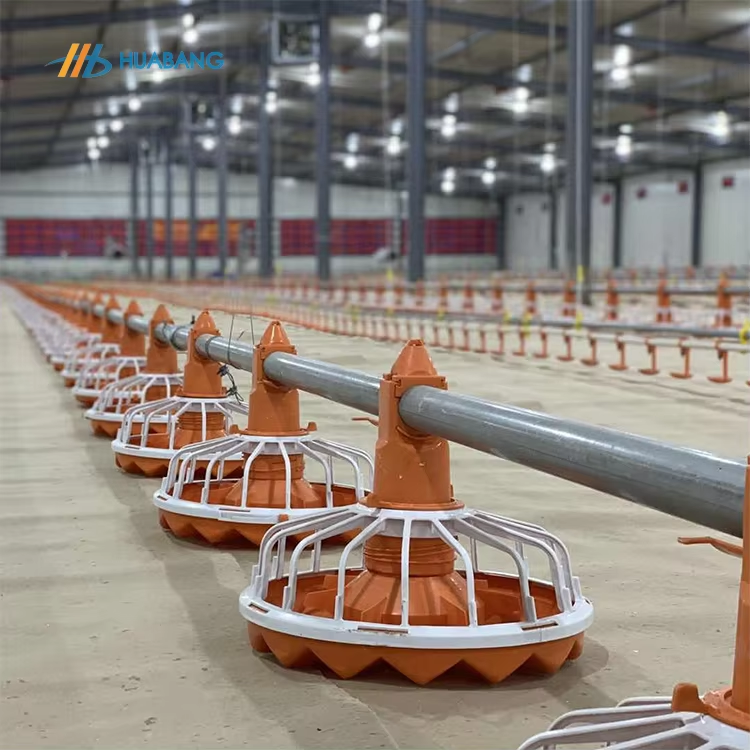
How Automatic Chicken Feed Line Systems Replace Repetitive Manual Feeding Tasks
Core components: Conveyor belts, auger systems, and programmable timers
An automatic chicken feed line integrates mechanical and electronic components to replace labor-intensive feeding routines. A motor-driven conveyor belt or auger moves feed from a central hopper along a suspended track, delivering consistent portions to every station. Programmable timers initiate feeding at preset intervals—eliminating the need for workers to carry buckets, estimate rations, or recall schedules. Augers typically convey dry mash or pellets through sealed tubes, minimizing contamination and spillage. Adjustable drop tubes or metering gates regulate flow above troughs, ensuring uniform distribution per bird. Optional fill-level sensors halt dispensing once troughs are full, preventing overfill. The control panel supports multiple daily cycles, with timing and duration tailored to flock age, breed, and production stage. This modular design replaces scooping, hauling, scattering, and refilling—converting a physically demanding, error-prone chore into a precise, hands-off operation.
Labor hours saved daily per 10,000-bird flock: 3.2–4.7 hours (FAO 2023 poultry automation benchmark)
Switching from manual to automated feeding delivers immediate time savings. Per the FAO’s 2023 poultry automation benchmark, a 10,000-bird flock reduces daily feeding labor by 3.2 to 4.7 hours—primarily by eliminating repeated bucket-carrying, visual ration estimation, and cleanup of spilled feed. With two or three daily cycles, weekly labor avoidance exceeds 20 hours. That time is redirected toward higher-value responsibilities: health monitoring, ventilation optimization, and equipment inspection—enhancing both operational efficiency and animal welfare.
Quantified Labor and Cost Savings from Chicken Feed Line Automation
30%–50% reduction in feeding-related labor costs across 12 U.S. and EU commercial farms (Poultry Science, 2022)
A 2022 study published in Poultry Science tracked 12 commercial layer and broiler farms across the U.S. and EU after implementing automated feed lines. It found feeding-related labor costs dropped 30% to 50%, depending on scale and local wage structures: smaller flocks (5,000 birds) saw ~30% reductions, while larger operations (50,000 birds) consistently achieved the upper end. Automation consolidates what once required multiple staff—measuring, carrying, and distributing feed—into oversight by a single operator managing digital controls. For a 20,000-layer farm, annual direct labor savings averaged $18,000–$24,000, excluding indirect gains like reduced overtime and improved worker retention. Payback periods frequently fell within two years—reinforcing automation as a financially sound step toward precision livestock farming.
92% fewer feed spillage incidents vs. manual bucket feeding (Iowa Layer Complex case study, 2023)
A 2023 case study at an Iowa Layer Complex housing 40,000 hens documented a 92% decline in feed spillage after installing an automated feed line—dropping from 150 incidents monthly under manual feeding to just 12. Unlike bucket-based delivery—which risks overfilling, uneven distribution, and floor spillage—the system dispenses measured portions directly into covered troughs. This cut feed waste by an estimated 2.3 tons annually, lowered rodent pressure and pest control costs, and significantly improved barn sanitation. The result is not only economic efficiency but also a more hygienic, biosecure environment aligned with modern poultry welfare standards.
Workforce Transformation: From Manual Labor to Technical Oversight with Chicken Feed Line
Reskilling pathways: Training staff for system monitoring, calibration, and preventive maintenance
Adopting an automatic feed line shifts workforce focus from physical repetition to technical stewardship. Staff now monitor real-time feed consumption patterns, calibrate auger speeds and drop-tube settings, and interpret sensor alerts—skills developed through manufacturer-led training, on-site mentorship, or mobile-enabled performance dashboards. Preventive maintenance—cleaning optical sensors, inspecting motor bearings, validating timer logic—becomes essential to avoid costly disruptions. This transition reduces physical strain while increasing job value and engagement. As farms integrate more connected systems, reskilling builds a resilient, data-literate team capable of sustaining high-performance poultry operations.
FAQs
What is an automatic chicken feed line system?
An automatic chicken feed line system is a modular mechanism that moves feed from a central hopper to decentralized feeding stations using components like motor-driven conveyor belts, augers, and programmable timers.
How does automation save labor hours?
By eliminating the need for manual bucket-carrying, ration estimation, and cleanup tasks, automated systems reduce daily feeding labor by 3.2–4.7 hours for a 10,000-bird flock.
What are the cost benefits of automation?
A study across 12 farms showed feeding-related labor costs decreased by 30%–50%, with annual savings up to $24,000 for a 20,000-bird farm.
How does it minimize feed waste?
The system significantly reduces spillage incidents by dispensing measured amounts directly into troughs, lowering feed waste and improving barn hygiene.
Do workers require training for these systems?
Yes, workers need training to monitor, calibrate, and maintain the automated feed line, transitioning their focus from manual labor to technical oversight.