
 EN
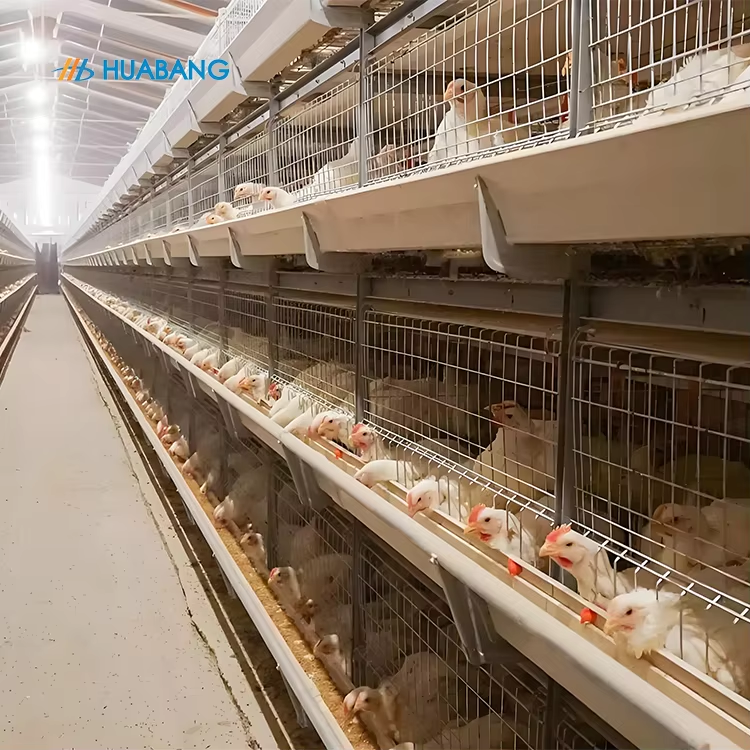
Biological & Production Requirements Drive Poultry Cage Design Variation
Anatomical and behavioral differences among layers, broilers, and pullets
The physical and behavioral traits of each bird type create distinct demands for a poultry cage system. A layer hen’s skeletal structure—optimized for sustained egg production—requires a cage floor with a precise 7–9 degree slope to allow eggs to roll gently into a collection trough, preventing losses from pecking or soiling. Broilers, bred for rapid weight gain, exert greater leg pressure and need larger floor mesh openings to ensure effective manure drop and drier litter, reducing footpad dermatitis risk. Pullets, still developing skeletal integrity, benefit from reduced jump distances within the cage to support bone strength before lay onset. Without these targeted adjustments, cages fail to align with biological priorities—potentially raising mortality by up to 2.3% (Animal Welfare Science 2022).
How production cycle length and output goals shape cage height, density, and access features
Production targets directly determine cage geometry and stocking logic. Layers in a 14-month laying cycle require a cage height of ~45 cm—tall enough for comfortable standing, yet compact enough to maximize vertical space efficiency. Broilers, processed in just 6–8 weeks, support higher stocking densities since birds are removed before space constraints significantly impact growth or welfare. These divergent timelines drive fundamentally different access needs: egg collection systems demand smooth, uninterrupted roll-out paths, while broiler cages prioritize large, controllable doors for stress-free removal—minimizing bruising that can downgrade carcass quality by an estimated $0.15 per bird (Agri Stats 2023). Ultimately, cage configuration reflects harvest frequency and the core biological commodity being optimized.
Farm Scale and Regional Context Determine Poultry Cage Specifications
Material durability, footprint, and assembly complexity for smallholder vs. industrial operations
Operational scale dictates material gauge, structural footprint, and assembly logic. Smallholder farms—typically managing fewer than 10,000 layers—favor lightweight, low-cost materials and tool-free assembly. A-type frame cages dominate this segment: their modular, 3- to 4-tier design allows phased expansion as flock size grows, minimizing upfront capital outlay. Assembly relies on simple bolted connections requiring no specialized technicians. In contrast, industrial operations housing over 60,000 birds demand maximum spatial density and structural longevity. Heavy-gauge galvanized steel frames are essential to support 6- to 8-tier fully stacked H-type systems. Footprint shifts from wide, pyramidal layouts to compact vertical blocks, and assembly becomes a precision engineering task requiring on-site technical supervision—particularly to align automated feeding and manure belts. For example, scaling from 30,000 to 60,000 layers typically triggers a shift from a semi-automatic 4-tier A-type system to a fully automatic 4–6 tier H-type configuration, trading simplicity for high-density, welded-frame resilience under constant machinery vibration.
Climate-adaptive poultry cage design: ventilation, corrosion resistance, and thermal mass in tropical vs. arid zones
Regional climate imposes specific material and design demands to maintain bird health and equipment longevity. In humid tropical zones, the dual challenges are rapid corrosion and heat retention. Frames require high-zinc galvanization (G275 or greater) on thin-gauge steel to reduce thermal mass and prevent daytime heat buildup. Open-sided, low-partition layouts work synergistically with cross-ventilation—often enhanced by roof insulation. In arid and semi-arid environments, extreme diurnal temperature swings and abrasive dust redefine priorities. Slightly higher thermal mass—such as thicker steel wire—is used to buffer temperature fluctuations, while corrosion protection focuses on sealing automated components against dust ingress: sealed bearing housings for feed trolleys and manure scrapers are standard. Ventilation shifts from natural cross-flow to tunnel-ventilated, closed-house systems—requiring cage layouts that form continuous air channels. Climate, therefore, reshapes not just materials but the entire operational logic of the cage system.
Automation Integration Enhances Mode-Specific Efficiency in Poultry Cage Systems
Automation transforms poultry cage environments into precision-management ecosystems, tailoring conditions to the unique physiological and behavioral demands of pullets, layers, and broilers.
IoT-enabled monitoring and climate control for pullet development and layer productivity
IoT sensors embedded in modern cage infrastructure continuously monitor temperature, humidity, ammonia levels, and bird movement—enabling real-time adjustments to ventilation, heating, or cooling. This ensures tight environmental control critical for pullet skeletal development and consistent layer egg formation. A 2024 industry analysis found that farms with automated environmental control achieved a 48% increase in egg production consistency and a 4.7% reduction in mortality across moderate-scale operations. By eliminating manual intervention, these systems remove the 40% error rate typical of human-managed climate adjustments—ensuring optimal conditions across all cage sections without labor spikes.
Feeding, manure removal, and egg collection automation tailored to flock size and breeding objective
Automation depth directly influences labor efficiency and output quality. The table below summarizes annual labor reduction by integration level, based on operational data from large-scale and smallholder farms.
| Automation Level | Key Features | Annual Labor Reduction |
|---|---|---|
| Basic | Automatic nipple drinking, semi-automatic feeding | Up to 30% |
| Medium | Automatic feeding and drinking, manual manure scraper | Up to 60% |
| Full | All functions automated, including environment control | Over 90% |
For broilers, precise feed delivery schedules prevent waste and optimize growth—reducing feed loss by 25% after switching to automated hoppers (Poultry Science Association, 2023). Layer-focused systems prioritize gentle egg collection belts to minimize cracks and manure removal cycles calibrated to flock density. A fully automated setup—feeding each trough, scraping manure centrally, and conveying eggs via belt—can cut manual tasks by over 90%, enabling one operator to manage tens of thousands of birds while meeting strict welfare and productivity benchmarks.
Niche Breeding Modes Demand Specialized Poultry Cage Configurations
Meeting the precise standards for niche markets like organic egg production requires a fundamental shift in poultry cage design—from basic containment to active support of natural behaviors, a requirement for certification and flock welfare.
Organic certification compliance: perch placement, litter access, and light regulation in modular poultry cage systems
Modular poultry cage systems offer a viable pathway to organic certification by integrating features often impractical to retrofit into conventional housing. Perches accommodate the instinct to roost; welfare standards mandate a minimum of 15 cm per hen, positioned to avoid fouling birds or equipment below. Continuous daytime access to a litter area—essential for pecking, scratching, and dustbathing—requires at least 250 cm² per bird under most organic programs. Modular designs enable a dedicated, easily managed litter compartment distinct from slatted or wire resting areas. According to the 2024 Organic Livestock Standards Handbook, functional partitioning of these areas is essential for compliance in permanent housing systems.
Light regulation forms the third pillar. Organic standards require a minimum eight-hour continuous nocturnal rest period, achieved through robust light traps or solid-walled sections within modular units to ensure true darkness. This integrates with programmable LED systems delivering uniform daytime light intensity of at least 20 lux at bird level—verified by certified sensors. The table below shows how modular components address each requirement:
| Certification Requirement | Standard Benchmark | Modular Poultry Cage Design Feature |
|---|---|---|
| Perch Placement | ≥ 15 cm/hen, avoiding fouling | Integrated, height-adjusted perches on non-wire sections |
| Litter Access | Continuous daytime access, ≥ 250 cm²/bird | Designated, separable litter compartment with controlled entry |
| Light Regulation | 8-hr continuous darkness, 20+ lux daytime | Light-trapped solid panels; zonal programmable LED arrays |
This task-specific engineering ensures producers can reliably replicate the environmental conditions needed to secure and maintain organic certification—a capability beyond the scope of standard cage systems.
FAQ Section
Why do poultry cage designs vary?
Poultry cage designs vary due to differences in bird types, their anatomical and behavioral needs, production cycle lengths, and environmental factors such as climate and farm size.
What factors should be considered in cage material choice?
Cage material choice depends on factors like durability, corrosion resistance, thermal mass compatibility with the climate, and structural requirements, especially in industrial setups.
How does automation benefit poultry farmers?
Automation reduces labor costs, minimizes errors in climate control, ensures precise feeding, and improves productivity and animal welfare by creating optimized management systems.
What are the requirements for organic poultry production?
Organic poultry production requires compliance with standards like adequate perch placement, litter access, and light regulation to support natural bird behaviors essential for certification.
How does regional climate impact poultry cage design?
In tropical regions, cages require corrosion resistance and enhanced ventilation, while in arid zones, designs must handle temperature fluctuations and protect components from dust.
Table of Contents
- Biological & Production Requirements Drive Poultry Cage Design Variation
- Farm Scale and Regional Context Determine Poultry Cage Specifications
- Automation Integration Enhances Mode-Specific Efficiency in Poultry Cage Systems
- Niche Breeding Modes Demand Specialized Poultry Cage Configurations
- FAQ Section