
 EN
EN
Core Purpose and Production Logic: Layers vs. Broilers
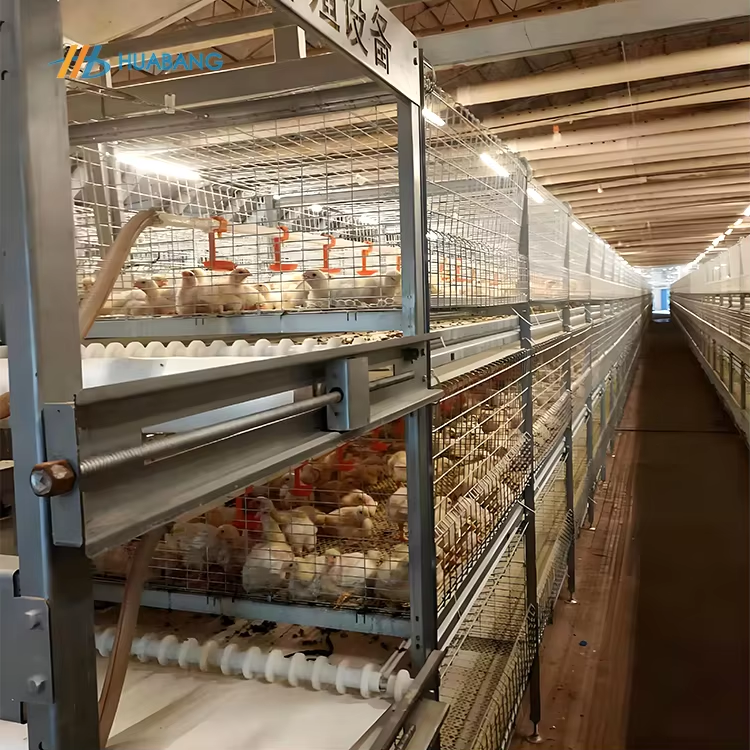
Layer chicken cage systems optimized for egg production longevity and hygiene
A layer chicken cage is engineered to maximize egg output and flock health over a production cycle of 72 weeks or more. Its primary design goal is to maintain egg cleanliness, reduce breakage, and support the hen’s long-term physiological needs. Floors are sloped at 8–12° so eggs roll gently onto a collection belt—minimizing contact with manure and feet. This immediate separation cuts shell egg contamination by up to 45% compared to floor systems (FAO 2023). Continuous manure removal via belts beneath each tier keeps ammonia levels below 10 ppm, preserving respiratory health and sustaining peak lay. Cages are stacked in 3- to 8-tier configurations, with each compartment housing 4–10 birds. Wire mesh is shaped to discourage feather pecking and cannibalism without restricting movement; nipple drinkers and feed troughs are positioned to reduce spillage. Well-managed systems routinely achieve 310–320 eggs per hen housed, with mortality under 4% (Hy-Line International 2024). By isolating small groups in a controlled environment, the system enables precise performance monitoring and rapid intervention—making it the operational backbone of commercial egg production worldwide.
Why broiler production overwhelmingly favors floor‑based systems over cages
Broiler chickens are selected for rapid muscle development, reaching slaughter weights of 2.5–3.5 kg in just 35–42 days. Placing such heavy, fast-growing birds in cages creates serious welfare and production challenges. Hard wire floors cause high rates of breast blisters, hock burns, and foot pad lesions—impacting 20–30% of caged broilers versus less than 5% in floor systems (European Commission 2022). Leg bones struggle to support body weight on rigid surfaces, increasing lameness and chronic stress. In contrast, deep-litter floors covered with wood shavings or straw allow natural behaviors like walking, scratching, and dust bathing—strengthening legs and reducing abnormal activity. The EU Broiler Directive (2007/43/EC) enforces a maximum stocking density of 33 kg/m² for floor systems, and many retailers require lower densities. No cage-specific welfare code exists for broilers because scientific evidence and legislation strongly discourage the practice. Floor systems also simplify ventilation and litter management in large, open-span houses—and carry significantly lower capital cost per bird than cage installations. As a result, over 95% of global broiler production relies on floor-based housing, with cages reserved almost exclusively for layer breeders.
Structural Design Differences in Layer Chicken Cage vs. Broiler Cage
Floor slope, tier configuration, and egg roll-out mechanics in layer chicken cage
The layer chicken cage centers on one priority: harvesting clean, intact eggs with minimal labor. A floor slope of 7° to 10° allows laid eggs to roll gently onto a front-mounted collection belt—keeping them away from droppings and reducing manual handling. Tier configurations (typically 3 to 8 tiers in A-frame or vertical layouts) maximize bird density per square meter while maintaining adequate airflow. Broiler cages, when used, omit the sloped floor entirely. Their flat steel mesh serves only to support rapid weight gain and ensure manure drops through. Since broilers are slaughtered at 6–8 weeks and produce no eggs, no roll-out infrastructure exists—making the structure simpler but functionally limited to meat production.
Mesh spacing, wire gauge, and load-bearing capacity: supporting 2 kg layers vs. 3+ kg broilers
Housing a 2 kg laying hen versus a 3+ kg broiler demands fundamentally different engineering. Layer cages use finer floor mesh—typically 25 × 50 mm—to prevent eggs from lodging and protect feet. Wire gauge is lighter (2.0–2.5 mm), as loads are modest and static. Broiler cages must withstand concentrated weight and frequent movement: floor mesh openings widen to 25 × 75 mm or more to pass heavy droppings, and wire gauge thickens to 3.0 mm or higher. Load-bearing capacity per square meter rises from ~40 kg in layer systems to over 70 kg for broilers. This structural shift increases material costs—but is essential to prevent failure under the pressure of rapid growth.
Stocking Density, Welfare Standards, and Regulatory Compliance
FAO and EU guidelines: space allocation per bird (kg/m²) and implications for cage design
International frameworks reflect divergent biological and welfare priorities. EU Directive 1999/74/EC mandates enriched layer cage designs provide at least 750 cm² of usable area per hen—including space for nest boxes and perches—effectively limiting stocking to 8–12 birds per square meter depending on body weight. In contrast, FAO welfare guidelines focus on floor-based broiler systems, recommending a maximum of 30–33 kg live weight per square meter to avoid respiratory stress and lameness. Because broiler cages are rarely used, no explicit cage-space standards exist; any viable system would need to accommodate over 40 kg/m² for a typical 2.5 kg bird while still allowing natural movement. These contrasting density requirements explain why layer cages prioritize egg collection and hygiene, while broiler production depends on spacious, behaviorally supportive floor environments.
Operational and Economic Implications for Poultry Farmers
The choice between layer cage systems and broiler floor-raising fundamentally shapes a farm’s cost structure, labor needs, and long-term profitability. A modern, automated layer house with multi-tier cages requires $80–$120 per bird space in initial capital (industry capital cost analysis 2023), but automation in feeding, egg collection, and manure removal cuts daily labor hours by over 60% compared to conventional floor systems. Broiler production uses lower-cost open-floor infrastructure but demands continuous labor for litter management, biosecurity monitoring, and manual catching—adding roughly 0.5–1.0 labor hour per flock cycle. While broilers offer rapid turnover (six- to seven-week cycles), layer operations deliver steady revenue from egg sales, with well-run caged systems achieving 90–95% peak lay and feed conversion ratios below 2.1 kg feed per dozen eggs (FAO 2022). Break-even for layer cage investment typically occurs within three to five years; broiler margin resilience hinges on efficient feed-to-meat conversion and low mortality (3–5% in well-managed flocks, per university trials 2020). For many producers, a hybrid model—maintaining a layer flock for daily cash flow while cycling broiler batches for volume—proves the most robust economic strategy.
FAQs
Why are layer chicken cages sloped?
The slope in layer chicken cages allows eggs to roll onto a collection belt, minimizing contact with manure or feet and maintaining shell cleanliness.
Why are broilers primarily raised on floor systems?
Broilers grow rapidly and require soft, deep-litter floors to reduce welfare issues like leg stress, foot pad lesions, and hock burns, ensuring healthy development and minimizing abnormalities.
What are the stocking density requirements for layers vs. broilers?
EU regulations require enriched layer cages to provide 750 cm² per bird, while broilers on floor systems are generally stocked at 30–33 kg per square meter, catering to their behavioral and respiratory needs.
How do layer cage systems improve farmer productivity?
Automated layer cage systems streamline feeding, manure removal, and egg collection, significantly reducing daily labor requirements and enhancing operational efficiency.
Are broiler cages ever used in production?
Broiler cages are rarely used, as floor-based systems are preferred globally due to better welfare standards and suitability for fast-growing birds.